
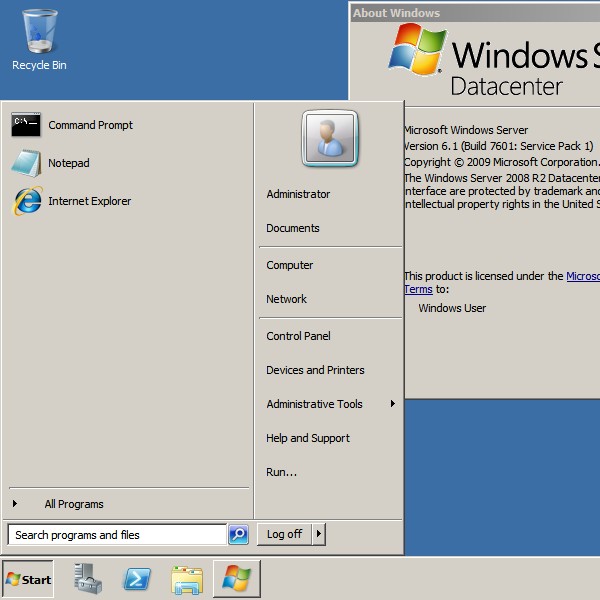
Microsoft Windows Server 2008 R2
2009, October 22
Windows Server 2008 R2, codenamed "Windows Server 7" is the eighth major version of the Windows NT operating system produced by Microsoft to be released under the Windows Server brand name. It was released to manufacturing on July 22, 2009, and became generally available on October 22, 2009, the same respective release dates of Windows 7. It is the successor to the Windows Vista-based Windows Server 2008, released the previous year, and was succeeded by the Windows 8-based Windows Server 2012.
Enhancements in Windows Server 2008 R2 include new functionality for Active Directory, new virtualization and management features, version 7.5 of the Internet Information Services web server and support for up to 256 logical processors. It is built on the same kernel used with the client-oriented Windows 7, and is the first server operating system released by Microsoft which dropped support for 32-bit processors, an addition which carried over to the consumer-oriented Windows 11.
It is the final version of Windows Server that includes Enterprise and Web Server editions, the final that got a service pack from Microsoft and the final version that supports IA-64 and processors without PAE, SSE2 and NX (although a 2018 update dropped support for non-SSE2 processors).
Seven editions of Windows Server 2008 R2 were released: Foundation, Standard, Enterprise, Datacenter, Web, HPC Server and Itanium, as well as Windows Storage Server 2008 R2. A home server variant called Windows Home Server 2011 was also released.